To choose an injection mold supplier for a Shenzhen hardware project, verify the factory that will build the tool and mold the parts, then assess the engineering handoff, machine fit, inspection plan and route from trial to production. A Shenzhen-facing sales or engineering team can support the project, but its location does not prove where manufacturing takes place.
Disclosure: This guide is published by Yiot Technology Co., Ltd., which provides global sales and engineering coordination for projects manufactured at the Dongguan base of Dongguan Aoyuan Plastic Products Co., Ltd. It is a sourcing checklist, not an independent supplier ranking.
Separate the project interface from the manufacturing site
For every candidate, record the legal sales entity, contracting and invoicing entity, manufacturing entity, factory address and the site responsible for mold trials and production. Ask which operations are performed in-house and which are subcontracted. This prevents a convenient Shenzhen contact point from being mistaken for a verified tooling or molding facility.
Five checks for a Shenzhen injection mold supplier shortlist
- Engineering handoff: Confirm who receives the 2D and 3D files, who raises DFM questions, how drawing revisions are controlled and how decisions are recorded.
- Tooling and machine fit: Review part size, resin, cavity count, expected volume, shot size, clamping force, tie-bar spacing, platen dimensions, mold size, inserts and automation requirements together.
- Trial-to-production path: Define the stages for DFM approval, steel release, first trial, corrections, sample approval, production transfer and change control. A fast first response is not the same as an approved production schedule.
- Inspection and acceptance: Identify critical dimensions, appearance zones, measurement methods, sampling or inspection frequency, records and acceptance criteria. Do not treat equipment accuracy as a universal molded-part tolerance.
- Quality-system scope: Check the certificate holder, factory address, standard, covered activities and validity period. Industry experience does not by itself establish an automotive- or medical-specific certification.
Prepare one RFQ package for every candidate
A comparable RFQ should include the available 2D and 3D files, resin and color requirements, expected annual and order quantities, appearance requirements, critical dimensions, validation needs, packaging and delivery location. Ask each supplier to state assumptions, exclusions, tooling ownership terms, revision rules and unresolved engineering questions. Quotes based on different inputs should not be compared as if they cover the same scope.
Plan the iteration loop before ordering the mold
Shenzhen hardware programs often involve design changes during verification. Before placing the order, agree how quickly questions will be acknowledged, who can approve changes, which files are authoritative and how a change affects cost and schedule. Require dated trial records and an action list after each mold trial. This creates a traceable path from engineering discussion to production approval.
How to verify a nearby manufacturing option
A factory visit or remote audit should follow the actual project route: design review, applicable toolmaking processes, mold assembly, trial equipment, dimensional inspection and sample records. Ask for evidence tied to the stated factory and relevant process. If the supplier uses another site or subcontractor, record its role before commercial approval.
Verified YIOT support and Dongguan manufacturing facts
- International project interface: Yiot Technology Co., Ltd. supports global sales and engineering communication.
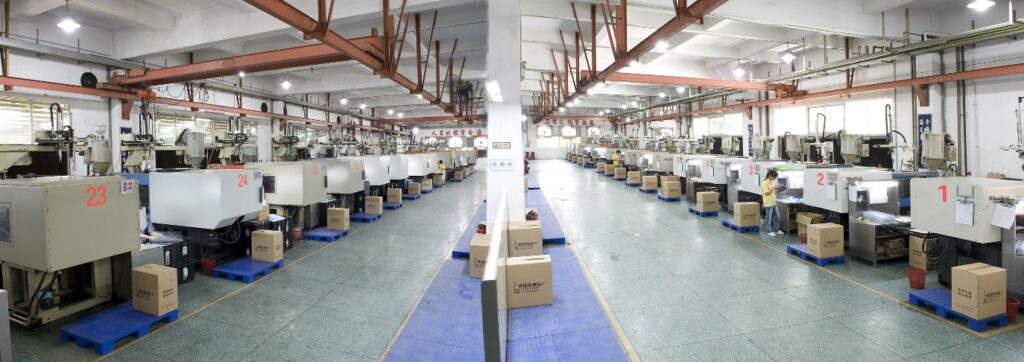
- Manufacturing entity: Dongguan Aoyuan Plastic Products Co., Ltd. operates the approximately 12,000 m² Dongguan manufacturing base.
- Injection molding: The base has 49 automated injection molding machines equipped with robots, covering 90T–1,200T.
- In-house capabilities: Mold manufacturing, CNC machining, EDM, milling, mold assembly, DFM engineering and dimensional inspection are available in-house.
- Quality management: The Dongguan manufacturing base operates under an ISO 9001:2015 quality management system.
- Conditional lead time: Typical custom mold lead time is 15–30 days, subject to mold complexity, cavity count, material, finish, validation and project requirements.
Frequently asked questions
Does a supplier for a Shenzhen project need to manufacture in Shenzhen?
No. What matters is that the buyer knows the actual manufacturing site, responsible legal entities, process ownership and communication route. Evaluate travel and coordination needs together with technical and quality fit.
Does a quick quotation prove that the supplier can meet the production schedule?
No. Quotation speed and production lead time are different. The tooling schedule should state its assumptions and milestones, including DFM, steel release, trials, corrections, validation and sample approval.
Can prototype approval be used as production approval?
Not automatically. Confirm whether the prototype and production parts use the same material, tooling, process, inspection method and acceptance criteria. Document any differences before production release.
Should the lowest mold price determine the supplier choice?
No. Compare the included scope, steel and component assumptions, trial and correction terms, inspection requirements, tooling ownership, maintenance responsibility, packaging and production support.
Prepare a Shenzhen hardware-project RFQ
Review YIOT’s DFM analysis workflow, the Dongguan manufacturing and quality page, and the broader Guangdong supplier-selection guide.
To request an evaluation, send your drawings and project requirements or email gerry.li@aiyiot.com.