Maintaining a consistent tolerance in custom injection molds for plastic air purifier parts is crucial for ensuring product integrity. This precision is vital as it directly affects the part’s functionality — ensuring the components fit together seamlessly while maintaining high aesthetic quality. For OEM/ODM manufacturers in the electronics and air purification sectors, understanding and implementing these precision techniques can be the difference between a successful product launch and costly revisions. Utilizing suppliers with ISO 9001:2015 certification helps ensure that your products meet exact specifications through rigorous assessments and engineering standards.
Key takeaways
- The journey of creating a custom injection mold for plastic air purifier parts begins with thoroughly understanding client requirements for material properties and part design.
- Design is the blueprint for precision in custom injection molds for plastic air purifier parts.
- Achieving detailed precision in mold production heavily relies on CNC (Computer Numerical Control) machining.
- Optimizing process parameters is a delicate balancing act crucial for ensuring consistent output in injection molding.
- Precision in mold manufacturing doesn’t end with the production process.
1. Initial Specifications and Material Selection
The journey of creating a custom injection mold for plastic air purifier parts begins with thoroughly understanding client requirements for material properties and part design.
Specific material selection is crucial as air purifier parts demand durability, thermal stability, and resistance to environmental factors like humidity and dust. Typically, materials such as ABS, polypropylene, and PC/ABS blends are favored for their excellent mechanical and thermal properties.
ABS is often selected for parts requiring good impact resistance and surface finish. Its ease of molding and capacity to produce intricate details make it a popular choice. For applications demanding higher strength and temperature tolerance, PC/ABS blends are utilized, offering enhanced durability and heat resistance. Polypropylene is preferred for components that need chemical resistance and lightweight qualities. Each material has specific applications, thus selecting the right material correlates directly to the part’s functional requirements and overall durability.
Detailed part specifications form the foundation for achieving mold precision. Specifications involve more than just material selection; they encompass a comprehensive analysis of part geometry, dimensions, and functional aspects. Identifying critical dimensions and tolerances ensures the mold design accommodates precise and repeatable outcomes.
Factoring in thermal and mechanical properties during this stage is pivotal. For instance, materials with high thermal expansion rates could lead to dimensional changes during molding. Thicker walls may be preferred for better structural integrity but could lead to longer cycle times due to slower cooling. Consequently, balancing these factors is essential to optimize the manufacturing process and ensure the mold’s longevity and efficiency.
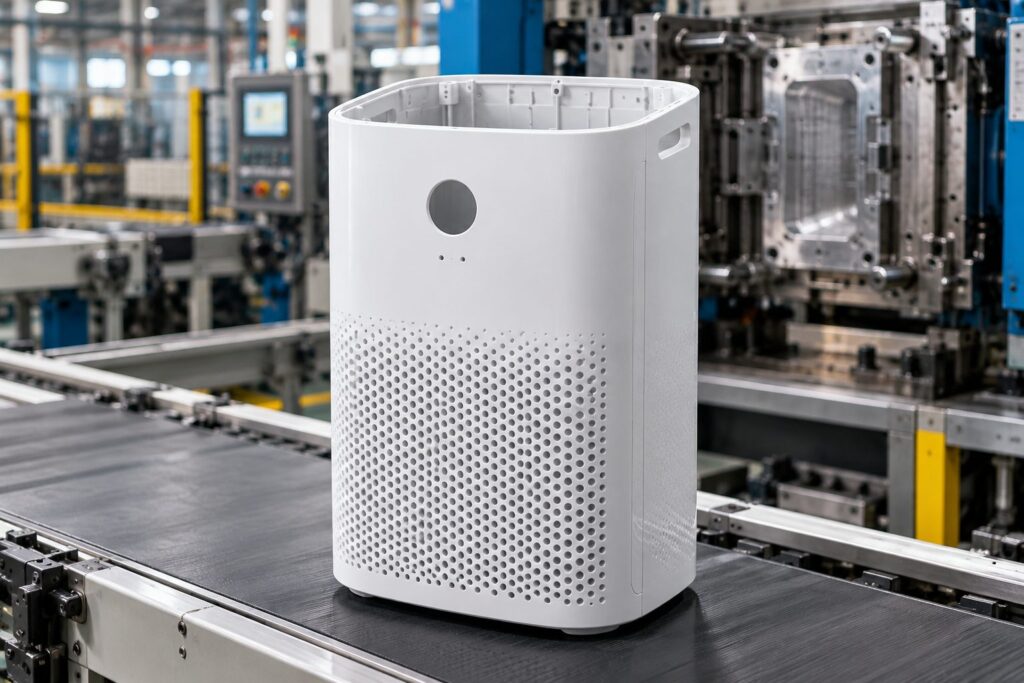
Understanding these initial specifications aligns the project’s objectives and ensures that the subsequent stages in mold production are carried out with precision, reducing potential errors during production and increasing the reliability of the final product.
Following this diligent specification analysis allows Yiot Technology Co., Ltd. to streamline the design and manufacturing process for Custom Injection Molds for Plastic Air Purifier Parts. This methodical approach not only meets your specific needs but also sets a strong foundation for achieving production precision.
2. Designing the Mold
Design is the blueprint for precision in custom injection molds for plastic air purifier parts.
Key design considerations focus on the dimensional accuracy and consistency required for high-precision molds. Incorporating tolerances at the design stage is crucial. Tolerances — the allowable limits of deviation in part dimensions — ensure that mold variations stay within acceptable bounds, preventing fit or function issues in the final product.
A critical part of mold design is selecting the right gating system. Gates control how molten plastic fills the mold, and choosing the appropriate type impacts both the mechanical characteristics and aesthetic quality of the finished air purifier parts. A well-designed gating system minimizes turbulence, reduces air entrapment, and promotes uniform filling, which are essential for molding parts that require tight tolerances and smooth surfaces, such as air purifier housings and components.
Designing for manufacturability (DFM) is also integral to creating efficient molds. DFM principles aim to streamline manufacturing processes, reducing costs and potential production delays. It is advisable to consider various factors that can influence material behavior in the cavity to anticipate potential issues. By foreseeing potential issues such as warpage or shrinkage, these risks can be addressed through informed design decisions.
Efficiency in the mold design phase extends to selecting materials and finishes that aid in easy release and durability of the molds, thereby prolonging their lifespan. This involves specifying surface finishes that reduce friction or utilizing coatings that resist abrasion and corrosive wear.
Consequently, applying these design principles is not merely about the mold’s technical accuracy; it is about setting the stage for a streamlined production process that meets both the aesthetic and functional needs of plastic air purifier components.
3. Precision Machining and Tooling
Achieving detailed precision in mold production heavily relies on CNC (Computer Numerical Control) machining.
CNC machines offer exceptional repeatability and accuracy, crucial for producing intricate mold components necessary for plastic air purifier parts. By automating the precision cutting and shaping processes, CNC machining provides the precision required for components demanding a high degree of fit and function.

Another critical technique in producing complex geometries is EDM (Electrical Discharge Machining). EDM is particularly valuable for features that are difficult or impossible to machine using traditional cutting tools, especially in hardened steels used for molds. This non-contact machining method uses electrical discharges to erode material, which means there’s no direct force applied on the part being machined, thus reducing the risk of deformation. The result is precise and intricate cavity detailing that meets exacting specifications.
Tooling choices significantly impact the final quality of molded parts. The type of steel selected for the mold, the hardness level achieved through heat treatment, and the surface coating applied all directly affect mold durability and part finish. High-hardness steels are often used for their wear resistance, essential for long production runs, while coatings like PVD (Physical Vapor Deposition) can enhance mold surface release properties and extend mold life.
Best practices in precision machining focus on maintaining rigorous quality standards throughout the tooling process. Buyers should consider regular calibration of equipment, use of high-quality tool steels for longevity, and advanced inspection techniques to verify component dimensions against design specifications.
Ultimately, precision machining and proper tooling are indispensable in meeting the demands of custom injection molds for air purifier components. Their combined contribution ensures the reliable production of parts that sustain functionality and aesthetic appeal in harsh operating environments.
4. Injection Molding Process
Optimizing process parameters is a delicate balancing act crucial for ensuring consistent output in injection molding.
Whether you’re molding components for household products or, like in this case, air purifier parts, the role of temperature and pressure control is pivotal. Precise maintenance of these variables eliminates defects, maintains dimensional accuracy, and ensures part integrity. Temperatures typically range between 200°C and 300°C for most plastic resins, and it’s critical to keep this steady to prevent uneven flow and internal stresses.
Pressure control, too, is a core consideration. It directly affects the density and strength of the final product. Injection pressures can range broadly from 10 MPa to over 100 MPa, depending on the material and part geometry. Fine adjustments here can address issues like incomplete filling or sink marks, all of which stem from improper pressure application during the molding cycle.
Machine calibration further underscores the precision needed in molding. Misalignments or wear in any part of the machine can throw a wrench in achieving consistent outputs. Regular calibration checks keep mold alignment and injection parameters within specified tolerances, crucially affecting the overall mold accuracy and production efficiency.
Monitoring and adjusting production variables in real-time is not just about ensuring that parts are within specifications but about optimizing cycle time and minimizing scrap. Advanced monitoring systems track temperature, pressure, and even machine vibrations, flagging any deviations from the norm. Real-time data enables operators to make immediate adjustments, minimizing variability and waste.
For buyers, ensuring supplier practices consider meticulous regulation of temperature and pressure, along with regular machine calibrations and continuous monitoring, can be key to maintaining the integrity and precision of components.
5. Quality Control and Inspection
Precision in mold manufacturing doesn’t end with the production process.
Rigorous quality control and inspection measures are crucial to ensure each mold meets exact specifications. Dimensional inspection tools, such as coordinate measuring machines (CMMs) and portable measuring arms, play a vital role in this stage. They verify that every detail aligns with customer drawings, minimizing defects before final production.
Inspection failures are often identified when there are anomalies in dimensions beyond pre-established tolerances. A common corrective action involves recalibrating the machinery or adjusting the mold dimensions. Inspection failures might also necessitate the redesign of specific mold components followed by further testing. Training in inspection methods is important to maintain team proficiency and reduce inspection errors.
Inspection Standards and Tools
| Inspection Method | Typical Tool Used | Why It Matters |
|---|---|---|
| Visual Inspection | Micrometers | Detects surface irregularities and defects |
| Dimensional Verification | Coordinate Measuring Machine (CMM) | Ensures all dimensions meet design tolerances |
| Surface Finish Evaluation | Profilometer | Confirms finish quality, essential for aesthetic and functional requirements |
| Part Weight Measurement | Precision Scale | Validates material consistency across all parts |
| Non-Destructive Testing | Ultrasonic Tester | Assesses internal part integrity without damage |
Inspection reports serve as an essential tool in providing feedback on mold and part compliance throughout the industry. They detail discrepancies and highlight areas that may require attention. These reports inform customers about compliance with specified standards and provide a historical record that supports continuous improvement. As a best practice, thoroughly examining these reports empowers decision-makers to understand failure points, facilitating precise quality improvements in subsequent production cycles. Careful review of each report aims to comply with client requirements, enhancing overall production quality.
6. Troubleshooting Common Issues
Injection molding precise air purifier parts is not without its challenges.
The key to maintaining high quality lies in promptly identifying and resolving common issues like warping and surface defects.
Identifying and Resolving Warping
Warping often stems from uneven cooling rates across the molded part, leading to deformations. To counteract this, ensure even mold temperature distribution and maintain consistent cooling rates across the entire mold. If warping persists, consider adjusting the packing pressure and time to achieve uniform cooling.
Tackling Surface Defects
Surface defects such as splay marks or burn marks can compromise the aesthetic and structural integrity of air purifier parts. These defects generally arise from inadequate venting or excessive injection speed. To mitigate them, check for proper venting channels and reduce the injection speed to decrease shear rate and optimize the melt flow.
Minimizing Rejection Rates
Consistently high rejection rates can significantly inflate production costs. Effective strategies include fine-tuning the machine settings and routine mold maintenance. Regularly calibrating the injection molding machine ensures process parameters remain within specified tolerances, reducing variability in output.
Common Misunderstandings in Mold Maintenance
One common misunderstanding is that less frequent mold maintenance saves time and cost, while in reality, neglected molds often lead to increased downtime and part rejects. Routine inspection and preventive maintenance are crucial for sustaining mold integrity and performance. Mold cleaning and lubrication should be scheduled and documented to prevent wear and tear, ultimately reducing the likelihood of defects.
For a deeper dive into common issues, refer to our detailed guide: Understanding Precision in Custom Injection Molds for Air Purifier Parts. Keeping a proactive approach to these issues can prevent costly repairs and quality lapses, ensuring the production of high-quality air purifier components.
Questions to Consider for Your Project
Before moving forward with your plastic air purifier parts project, it’s crucial to reflect on several key aspects to ensure precision and quality.
Firstly, consider if your material choice aligns with the specific requirements and properties essential for the part’s performance. It’s also wise to align yourself with a supplier whose focus is unwaveringly on precision. Verify that your supplier’s process controls are robust and reliably maintain part consistency. Additionally, ensure your supplier has quality checks that meet your specific standards and requirements. These thoughtful questions can guide your project’s success.
Frequently asked questions
What materials are best for air purifier parts?
ABS and PC are commonly used due to their durability, thermal stability, and ease of molding. They provide a good balance between strength and cost. Also, their ability to be precisely molded to tight tolerances makes them ideal for complex components.
How do you ensure precision in mold making?
To ensure precision in mold making, it is advisable to inquire about process controls like CNC and EDM machining, and to request quality inspections from your supplier. Industry standards serve as a guideline to optimize each step from material selection to final inspection, ensuring accuracy and consistency.
Request a project review
Send the 3D model, 2D drawing, material requirements, annual volume and critical dimensions. The team will identify open technical questions before tooling is quoted.