Electrical Discharge Machining (EDM) milling is crucial in fabricating precise injection mold components. It offers exceptional control over dimension and surface finish, crucial for the high precision demands of injection molds. At Yiot Technology Co., Ltd., located in Dongguan, EDM milling is used to produce components with unique geometries that would be difficult or impossible to achieve using traditional machining techniques. This process employs electrical discharges to shape hard metals into the precise forms required by custom injection molds, all while maintaining management system quality through ISO 9001:2015 certification. EDM milling stands out not only for its precision but also for its ability to machine complex shapes from hardened materials, vital for the consistent performance of mold components.
Key takeaways
- The initial preparation stage in EDM milling is critical, setting the foundation for achieving precise mold components.
- Setting up the EDM (Electrical Discharge Machining) machine is a critical step to ensure precision in manufacturing injection mold components.
- Electrical Discharge Machining (EDM) milling is a precise process that relies on controlled electrical discharges to shape metal into complex mold components.
- The final stages of EDM milling for injection mold components involve rigorous inspection to ensure quality.
- Electrode wear and electrical arcing are frequent challenges in EDM milling, each requiring preemptive measures to mitigate.
1. Initial Preparation Materials and Tooling
The initial preparation stage in EDM milling is critical, setting the foundation for achieving precise mold components.
Choosing the right workpiece material is the first step. Typically, materials such as hardened tool steel, stainless steel, or aluminum alloys are selected based on the durability requirements and the intricacy of the final mold. For instance, hardened tool steel is often preferred for its wear resistance and ability to maintain tight tolerances under high-stress conditions, making it ideal for long-run production molds.
Equally important is the choice of electrode material, which greatly affects the milling efficiency and outcome. Copper and graphite are the most commonly used electrode materials due to their excellent electrical conductivity and ability to withstand high thermal loads. Copper offers superior surface finish capabilities and is ideal for intricate detail work, whereas graphite’s lower cost and ease of machining make it suitable for larger volume runs with simpler geometries. Each choice balances cost, erosion efficiency, and the desired surface finish.
Tooling considerations can significantly impact the accuracy and repeatability of the EDM milling process. The use of precise fixtures and mounts is essential to maintain the stability of both the electrode and the workpiece throughout the machining cycle. These fixtures must be designed to minimize movement and vibration, as even slight shifts can lead to significant deviations in the final part dimensions.
Preparation for dimensional inspection aligns with regulatory standards such as ISO 9001:2015, which emphasizes the need for documented processes and traceable measurements. Calibration of measuring tools, like micrometers and calipers, ensures accuracy in verifying critical dimensions against the CAD specifications. This step involves creating comprehensive inspection plans that document all critical-to-function tolerances, thereby mitigating the risk of parts that fail to meet stringent customer requirements.
For those interested in exploring more about CNC-related considerations in mold production, you can dive deeper into the specifics by visiting our CNC Machining for Injection Molds Factory Dongguan.
2. Setting Up the EDM Machine
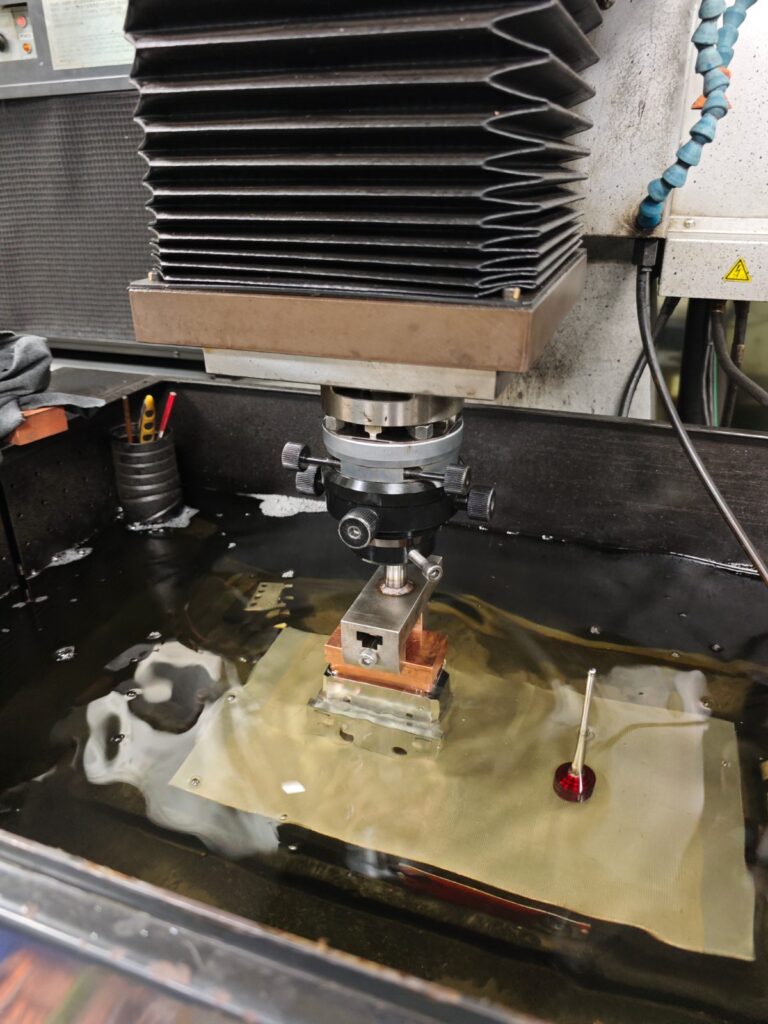
Setting up the EDM (Electrical Discharge Machining) machine is a critical step to ensure precision in manufacturing injection mold components.
This process requires meticulous calibration and configuration of several elements.
Calibration for Precision
The first task is the precise calibration of the EDM machine. Operators meticulously adjust the machine to correct misalignments and ensure accurate tooling. This involves setting the spark gap, which is often in the micrometer range. It’s essential that this gap is uniformly maintained to achieve dimensional accuracy. Proper calibration minimizes the chances of dimensional errors, critical for complex geometries demanding tight tolerances.
Programming the Tool Path
For manufacturing intricate injection mold components, programming the tool path is crucial. This involves creating a digital model where the paths are defined, accommodating complexities such as undercuts and non-linear profiles. The tool path must be optimized to minimize tool wear and streamline material removal, enhancing the process’s efficiency.
Adjusting Electrical Parameters
Electrical parameters influence the material removal rate and the surface finish quality. Adjustments are made to the current amperage, pulse duration, and frequency to control the discharge energy. Typically, a higher discharge energy is used for roughing operations, whereas lower energies are preferred for finishing processes. This careful adjustment allows for efficient machining while preserving the workpiece’s surface integrity.
Ensuring Dielectric Fluid Involvement
Dielectric fluid plays a pivotal role in EDM milling by flushing away eroded debris and controlling the spark gap. The fluid’s breakdown voltage is essential to prevent short circuits. Regular checks on its cleanliness and temperature are necessary—contaminated or overheated dielectric fluid can lead to inefficient machining and surface defects. The setup must include a well-maintained fluid system with filters and cooling mechanisms in place to ensure optimal performance.
Consequently, these setup measures significantly impact the efficiency and precision of EDM milling, especially for complex injection mold components. Each detail, from calibration to fluid management, is indispensable for achieving high-quality results.
3. The EDM Milling Process
Electrical Discharge Machining (EDM) milling is a precise process that relies on controlled electrical discharges to shape metal into complex mold components.
In this technique, a series of rapid, repetitive electrical sparks—discharges—are fired between the workpiece and an electrode, which serves as the tool. The sparks create intense localized heat, between 8,000°C to 12,000°C, which melts and vaporizes the metal in microscopic amounts. This process can effectively machine intricate geometries, making it ideal for mold components where conventional mechanical cutting proves challenging.
Control of Spark Frequency and Power Settings
Spark frequency and power settings are critical in EDM milling. The frequency, measured in Hertz (Hz), and power applied to each spark influence both the material removal rate and the surface finish quality. Too high a frequency might speed up the process but risks poor finish quality and increased electrode wear. Conversely, low frequency may yield a smoother surface but at the cost of productivity. Therefore, operators must fine-tune these parameters to match the workpiece’s material properties and the desired finish, balancing speed and precision.
Challenges with Maintaining Finish Quality
Maintaining a consistent finish quality is a considerable challenge in EDM milling. Variations in spark energy, incorrect electrode polarity, or unstable electrical conditions can lead to non-uniform surface textures. Achieving the desired surface finish relies heavily on stable operational conditions and frequent checks to adjust parameters as the material properties or electrode wear change, ensuring that each pulse remains effective and uniform.
Monitoring for Consistency
Monitoring the EDM process involves inspecting the output for consistency and making real-time adjustments to maintain specifications. An operator may use sensors to oversee the discharge gaps and signal consistency, along with thermal imaging to ensure the process remains within safe operational limits, avoiding overheating. Regular process assessments help in predicting wear patterns and adjusting spark parameters to compensate, effectively keeping the process under control. Buyers should specify their tolerance and precision requirements on drawings when sourcing EDM-milled components to ensure the output meets their criteria.
4. Inspection and Post-Processing
The final stages of EDM milling for injection mold components involve rigorous inspection to ensure quality. Coordinate measuring machines (CMMs) serve as the cornerstone for dimensional verification. These sophisticated devices utilize probe tips to measure the geometry of the finished mold components with exceptional accuracy, often to within microns. Achieving precision that aligns with the initial design specifications is essential for ensuring compatibility with other mold components.
Surface finish quality is another critical parameter in the inspection process. Surface finish assessment tools, such as profilometers, assess the texture of the machined surfaces. Precise control over surface roughness reduces the potential for issues, such as poor fit or increased wear during mold operation. During inspection, any deviations in surface finish are identified, contributing to optimal performance in the final product.
Subsequent to inspection, it’s important to consider post-processing activities to prepare components for use. For example, deburring, where unwanted rough edges or burrs left by initial machining are carefully removed, is standard practice to prevent potential interference during component assembly and operation. Cleaning processes also ensure that residues, such as minute metallic particles or dielectric fluid remnants, are thoroughly eliminated, promoting both aesthetic appeal and functional efficiency.
The culmination of these processes is a focus on quality assurance check practices. One should ensure that each component complies with the customer’s specifications and industry standards before authorizing packaging and delivery.
Key Specifications in EDM Milling
| Property | Typical Value | Why it Matters |
|---|---|---|
| Dimensional tolerance | — | Ensures fit with other mold components |
| Surface roughness | Ra 0.8 – 1.6 µm | Important for reducing drag and wear in operation |
| Post-processing deburring | — | Eliminates assembly interference and improves safety |
| CMM Precision | Within microns | Confirms adherence to design specifications |
| Cleaning process efficacy | High | Removes operation-altering residues |
Careful attention to these stages not only influences the quality and precision of the molds but directly impacts their longevity and performance once employed in production environments.
5. Avoiding Common Pitfalls in EDM Milling
Electrode wear and electrical arcing are frequent challenges in EDM milling, each requiring preemptive measures to mitigate. Identifying electrical arcing is pivotal. Arcing occurs when excess current leads to improper spark gap management, which degrades both the electrode and workpiece surface. Maintaining a precise gap is essential; frequent adjustments based on the material resistance and monitoring of current flow can avert this issue.
In extended milling cycles, electrode wear becomes apparent. As erosion naturally occurs during EDM, planning for compensatory measures is key. Use electrodes designed with wear compensation in mind, ensuring alterations in shape are monitored and corrected in real-time through automated offset systems. Changing or rotating electrodes can also prolong tool life and contour fidelity, especially with intricate designs.
Managing thermal stresses on workpieces requires diligent attention to both the dielectric fluid and the machining intervals. The primary role of the dielectric fluid is cooling; hence, selecting fluids with optimal viscosity and thermal properties is crucial. Avoid extended uninterrupted cycles that lead to localized heating; incorporate controlled pauses to disperse heat and allow thermal equilibrium.
Recognizing signs of dielectric fluid contamination is crucial for process stability. Contaminants typically manifest as debris accumulation, altering the discharge stability and energy transfer efficiency. Regular inspection and filtration of the fluid prevent this deterioration. Indicators such as abnormal ignition delays or uneven workpiece erosion surfaces suggest contamination and necessitate fluid replacement or filtration system checks.
This can safeguard the EDM milling process by reducing downtime and enhancing overall efficiency.
Considerations for Your EDM Project
Material selection plays a crucial role in ensuring mold longevity, with high-strength alloys often preferred for their wear resistance.
Factors like electrode size, spark alignment, and machine calibration significantly impact EDM machining precision, influencing dimensional tolerances. Consequently, while EDM milling can handle intricate shapes and tight tolerances, it typically incurs higher costs due to slower material removal rates. For less complex parts, traditional milling might be a more cost-effective choice. Finally, confirm your own material’s conduction and machining requirements against those cited here to ensure project compatibility.
Frequently asked questions
How does EDM milling enhance mold component precision?
EDM milling enhances precision by using electrical discharges to erode material with high accuracy, allowing for intricate designs and tight tolerances. This process is ideal for creating complex shapes that conventional machining might struggle to achieve.
What are the key material considerations for EDM milling?
Key considerations include the workpiece material’s electrical conductivity and hardness. Conductive materials like steel alloys are preferable for EDM milling, ensuring efficient erosion and maintaining required EDM parameters.
Request a project review
Send the 3D model, 2D drawing, material requirements, annual volume and critical dimensions. The team will identify open technical questions before tooling is quoted.