Liquid silicone rubber (LSR) overmolding can combine a soft sealing or gripping feature with a rigid plastic or metal substrate. For a medical-device component, successful overmolding depends on the substrate, interface design, tooling, flash limits, material documentation, manufacturing environment and validation plan working together.
This guide explains the engineering questions buyers should resolve before tooling. It does not assume that every LSR supplier has the same quality-system scope, controlled environment or validated process.
 Peter
PeterEngineering Manager · 15+ years in plastic and silicone mold development Updated September 21, 2026
Key takeaways
- Start with the device’s intended use, material and regulatory requirements rather than a generic LSR specification.
- Decide whether the design relies on chemical bonding, mechanical retention or both.
- Define acceptable flash, parting-line location, sealing surfaces and test methods before mold design is frozen.
- Treat substrate preparation, insert handling and process control as part of the manufacturing route.
- Verify a supplier’s actual quality system, environment and documentation against the project requirements.
What is LSR overmolding?
LSR overmolding forms a silicone feature around or onto a previously made substrate. The substrate may be a plastic component, metal insert or another approved material.
Depending on the application, the silicone may provide a seal, grip, flexible interface, protective surface or retention feature. Unlike a separately molded silicone part that is later attached with adhesive, overmolding moves bonding, positioning and flash control into the molding process. That makes tooling and validation decisions especially important.
Begin with intended use and material requirements
The word “medical” does not define one universal process. A housing, external grip, fluid-contact component and surgical-use part can have very different requirements.
Before requesting a quotation, the buyer should identify:
- whether the part contacts the patient, fluid path or drug;
- the required LSR grade and its supporting supplier documentation;
- sterilization or cleaning exposure, if any;
- temperature, chemical and mechanical conditions in use;
- color, hardness and appearance requirements;
- traceability and documentation expectations;
- environmental controls required during manufacturing or packaging; and
- the tests and approvals required before production release.
The material manufacturer, device owner and relevant regulatory specialists should confirm material suitability. A mold supplier should not replace that approval by simply recommending a generic “medical-grade” silicone.
Chemical bonding, mechanical retention or both?
The connection between LSR and the substrate is one of the first design decisions because bonding behavior depends on the exact materials and process conditions.
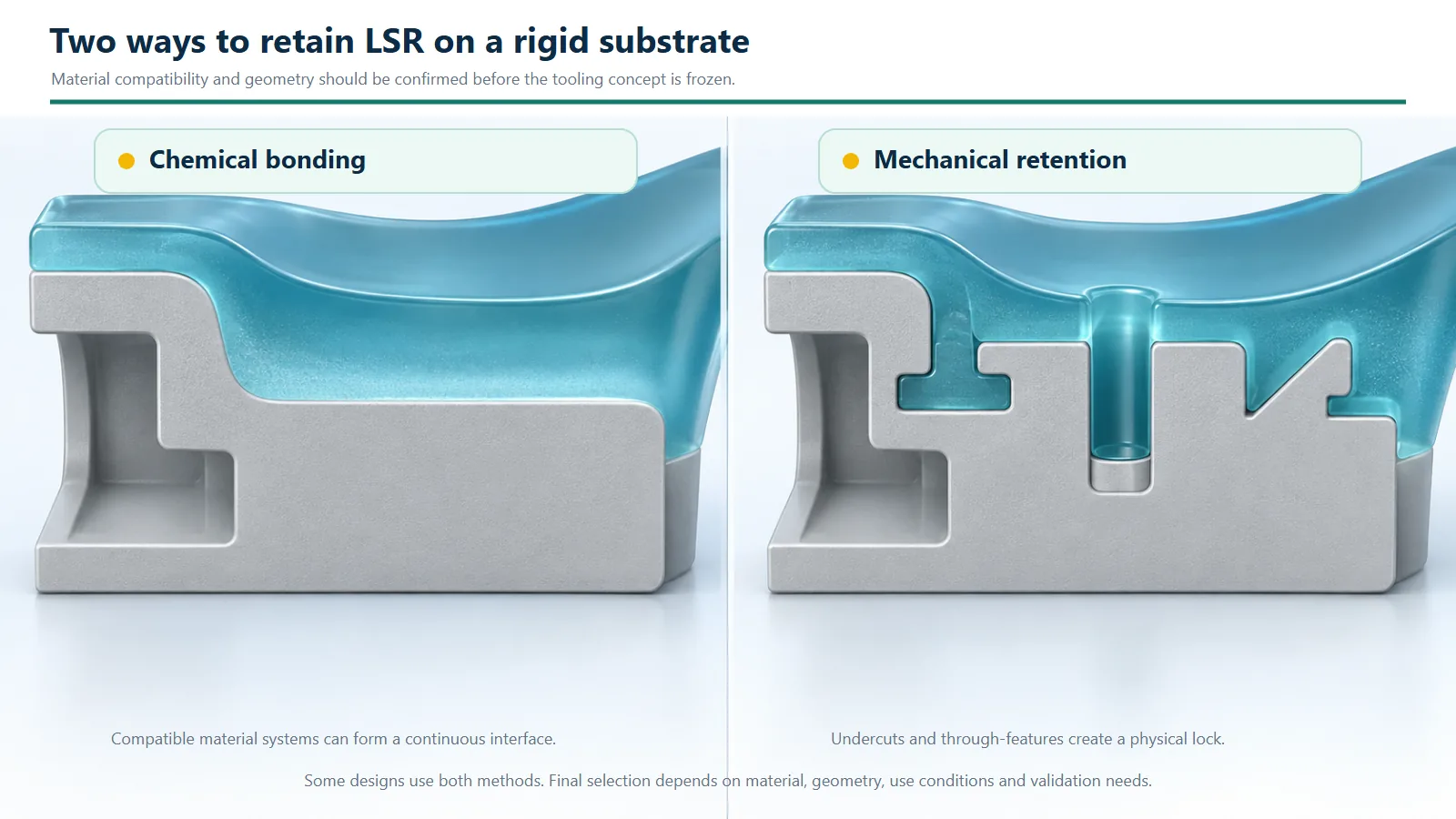
Chemical bonding
Some LSR systems are designed to bond to selected substrates under defined conditions. Performance can depend on the exact material grade, additives, surface condition, temperature and process window. A result achieved with one resin cannot automatically be transferred to another.
Mechanical retention
Undercuts, through-holes, grooves and other interlocking features can provide mechanical retention. These features may reduce reliance on chemical adhesion but can add molding, demolding or cleaning challenges.
Combined approach
Some projects use both bonding and mechanical retention. The validation plan should define how the interface will be tested, including the sample condition, test direction, speed, environment and acceptance limit. A generic peel-strength value should not be accepted without matching it to the actual material pair and test method.
DFM questions for an LSR overmolded part
A focused DFM review should consider the complete interface rather than only the silicone geometry.
Substrate geometry and placement
The insert must be located consistently and resist movement during injection and curing. Datum features, loading direction, orientation controls and potential insert deformation should be reviewed before tooling.
Shutoffs and flash control
LSR can enter very small gaps. Shutoff geometry, surface condition, insert variation and clamp strategy affect flash. The drawing should identify functional sealing surfaces and define how flash will be measured or judged.
Venting and filling
Venting must support filling without creating unacceptable flash or surface defects. Gate position, flow path, air traps and weld locations should be reviewed together.
Demolding
LSR’s flexibility can help release undercuts, but excessive stretch or uncontrolled ejection can damage a soft part. The tool concept should account for part removal, handling and potential deformation.
Wall thickness and cure behavior
Large thickness transitions can affect cure time, shrinkage and dimensional consistency. Uniform geometry is helpful, but functional requirements may require local changes that need simulation or trial evaluation.
Tooling and process-control considerations
An LSR overmolding tool may need close control of insert location, cavity sealing, temperature and material delivery. The appropriate mold construction depends on the substrate, part size, cavity count, material and production volume.
Useful project records can include:
- approved material and substrate specifications;
- insert preparation and handling instructions;
- mold and cavity identification;
- defined process parameters and allowed ranges;
- inspection method and sampling plan;
- nonconformance and corrective-action records; and
- agreed traceability from supplied materials to production lots.
The scope and retention period of these records should be defined by the customer’s project and quality requirements. They should not be presented as proof of certifications outside the supplier’s documented scope.
Inspection and validation planning
Inspection begins with a clear drawing and acceptance method. The plan should connect every critical requirement to an appropriate inspection or test method.
For an LSR overmolded component, the plan may include:
- insert position and orientation;
- critical dimensions after molding;
- flash and parting-line appearance;
- silicone coverage and voids;
- surface contamination or damage;
- adhesion or mechanical-retention testing;
- sealing or leak testing where the device design requires it; and
- packaging and handling checks.
Soft silicone features can be difficult to measure without deforming them. The drawing should match each critical characteristic to a suitable fixture, instrument or test method. Equipment accuracy by itself does not establish the final part tolerance.
Validation terminology such as IQ, OQ and PQ should only be used when the customer has defined the required protocol, responsibilities and acceptance criteria. It should not be added to a supplier page as a universal promise.
Quality-system and environmental-control questions
Medical-device buyers should verify the certificate holder, scope, production route and environmental controls rather than infer them from general marketing language.
A buyer should verify:
- the legal entity named on each certificate;
- the current certificate scope and validity;
- whether the actual production route is covered;
- the environmental-control and monitoring records required by the project;
- material traceability, change control and record-retention procedures; and
- responsibilities for device-level validation and regulatory submissions.
Questions to ask an LSR overmolding supplier
- Which exact LSR and substrate grades have been reviewed for this design?
- Does the interface rely on chemical bonding, mechanical retention or both?
- How will inserts be located, prepared and protected from contamination?
- Where will the parting line and gate be located?
- What flash limit applies, and how will it be inspected?
- Which dimensions or tests are critical to function?
- What trial samples and reports are included?
- Which quality-system, environmental and documentation requirements can the actual production route support?
- Who owns material approval, device validation and regulatory-submission responsibilities?
- How will changes to material, tooling or process be controlled and communicated?
How YIOT evaluates an LSR overmolding RFQ
YIOT can review LSR overmolding projects based on supplied part files, material requirements, substrate, annual volume, critical characteristics and validation needs.
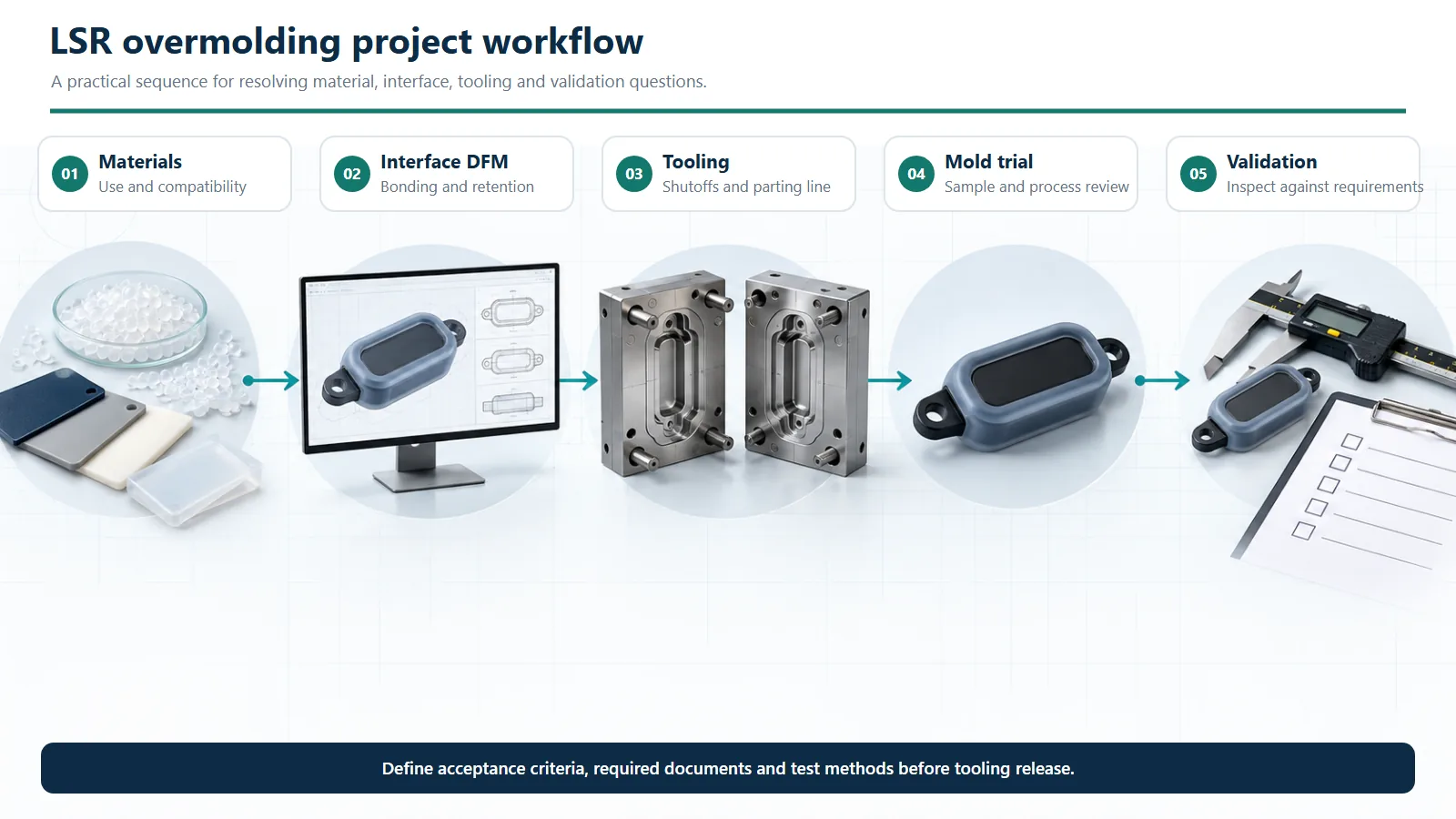
Support may include DFM discussion, mold-development planning, sample evaluation and project-specific inspection discussion. LSR capability has been confirmed. Specific equipment fit, material-grade coverage, bonding performance, environmental controls and regulated documentation must still be confirmed for the individual project. No universal certification, bond-strength or tolerance claim applies.
Buyers can review the current machining and inspection scope on the Facility & Quality page and application context on the Medical page.
Frequently asked questions
Is LSR overmolding always better than adhesive assembly?
No. Overmolding can reduce assembly steps and create an integrated interface, but it may require more complex tooling and validation. The best route depends on volume, geometry, material compatibility, service conditions and inspection requirements.
Can any LSR bond to any thermoplastic?
No. Bonding depends on the exact LSR, substrate grade, surface condition and process. Mechanical retention may be required when a reliable chemical bond cannot be validated.
Does an ISO 9001 quality system automatically cover every medical-device requirement?
No. Buyers must verify a supplier’s actual certification scope and whether the intended production route meets the project’s regulatory, environmental and quality requirements.
What tolerance can an LSR overmolded part hold?
There is no universal value. Geometry, material, substrate variation, mold design, cure behavior and measurement method all affect the result. Critical tolerances should be reviewed by feature.
Request an LSR overmolding project review
Send the 3D model, 2D drawing, intended LSR and substrate grades, annual volume, critical dimensions, flash limits and validation requirements. The team will identify open technical questions before tooling is quoted.
Submit project informationPeter
Peter is an Engineering Manager with more than 15 years of experience in plastic and silicone mold development and design. His work focuses on translating product requirements into practical tooling plans, reviewing manufacturability risks, and supporting clear technical coordination throughout mold development.